Category: Uncategorized

  • Coroplast, Explained: Thickness, Flute Direction, and How Long Signs Last

    Coroplast, Explained: Thickness, Flute Direction, and How Long Signs Last

    Most yard sign orders come down to one material: coroplast, the corrugated plastic that props up campaigns, open houses, and grand-opening arrows on every street corner. It looks like a single product, but two coroplast signs can behave very differently depending on two numbers you may never have thought about, the sheet thickness and the flute direction. Get either wrong and the sign either bends in the first gust or refuses to take a stake at all. Here is what those specs mean and how to order them on purpose.

    What coroplast actually is

    Coroplast is a genericized brand name for extruded corrugated polypropylene: two flat plastic faces bonded to a middle layer of hollow vertical channels, exactly like cardboard with the paper swapped for plastic. Those hollow channels are the flutes, and they are the whole reason the material is light, cheap, weatherproof enough for short outdoor runs, and able to swallow a wire stake. The polypropylene is naturally water-resistant, so rain is a non-issue. Sun is the real enemy, which is why lifespan, covered below, is the spec buyers most often misjudge.

    Thickness: 4mm, 6mm, and 10mm

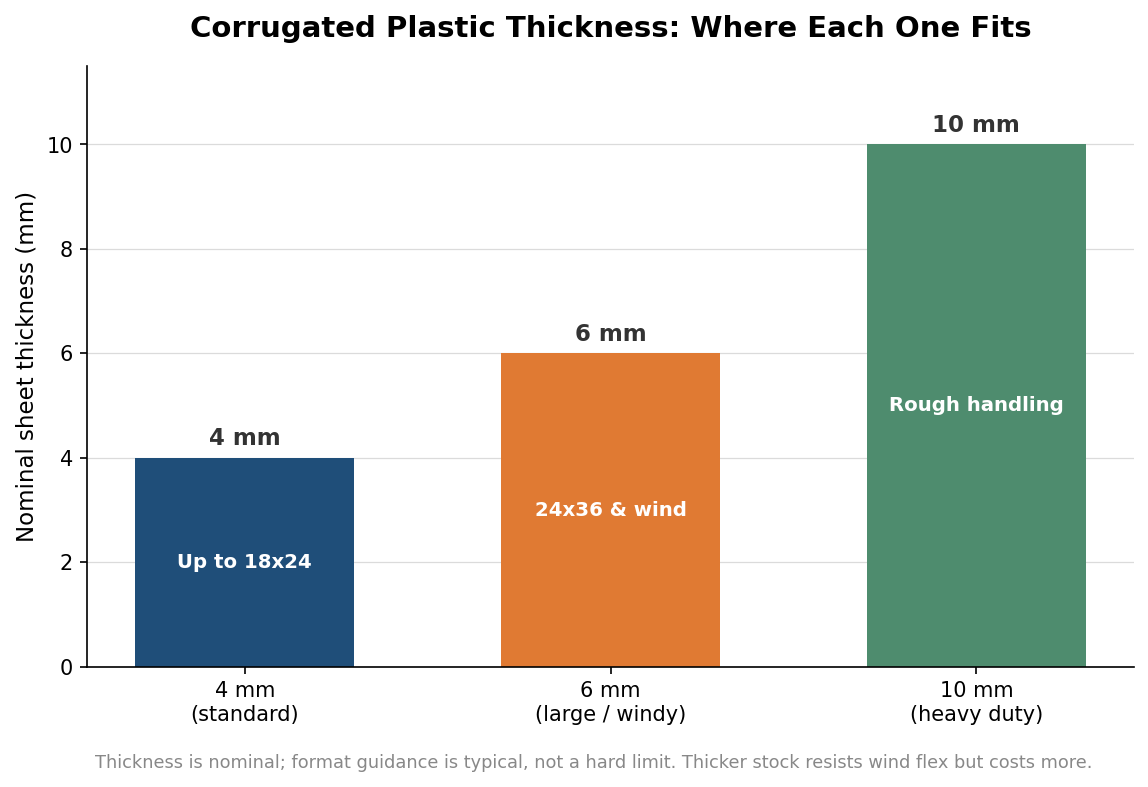
    Thickness is the first lever. The default for standard yard signs is 4mm, the workhorse grade behind virtually all political and real estate signage at sizes up to about 18 by 24 inches, supported by an H-wire stake. It is light and rigid enough for the job and the cheapest to print at volume. Step up to 6mm when the sign gets bigger, roughly 24 by 36 inches and up, or when it will live in a windy, exposed spot. The extra millimeters buy meaningful stiffness while keeping weight low, so the panel does not flex and fatigue at the stake line.

    The heavy grade is 10mm, chosen for maximum rigidity and impact resistance on large-format directional signs, construction-site boards, and anything that has to stand flat without a frame at sizes up to four by eight feet. The tradeoff is straightforward: each step up in thickness adds rigidity and weight but also cost per unit, so there is no reason to pay for 10mm on a lawn sign that a 4mm sheet handles fine. Match the grade to the size and the wind, not to a vague sense that thicker is safer.
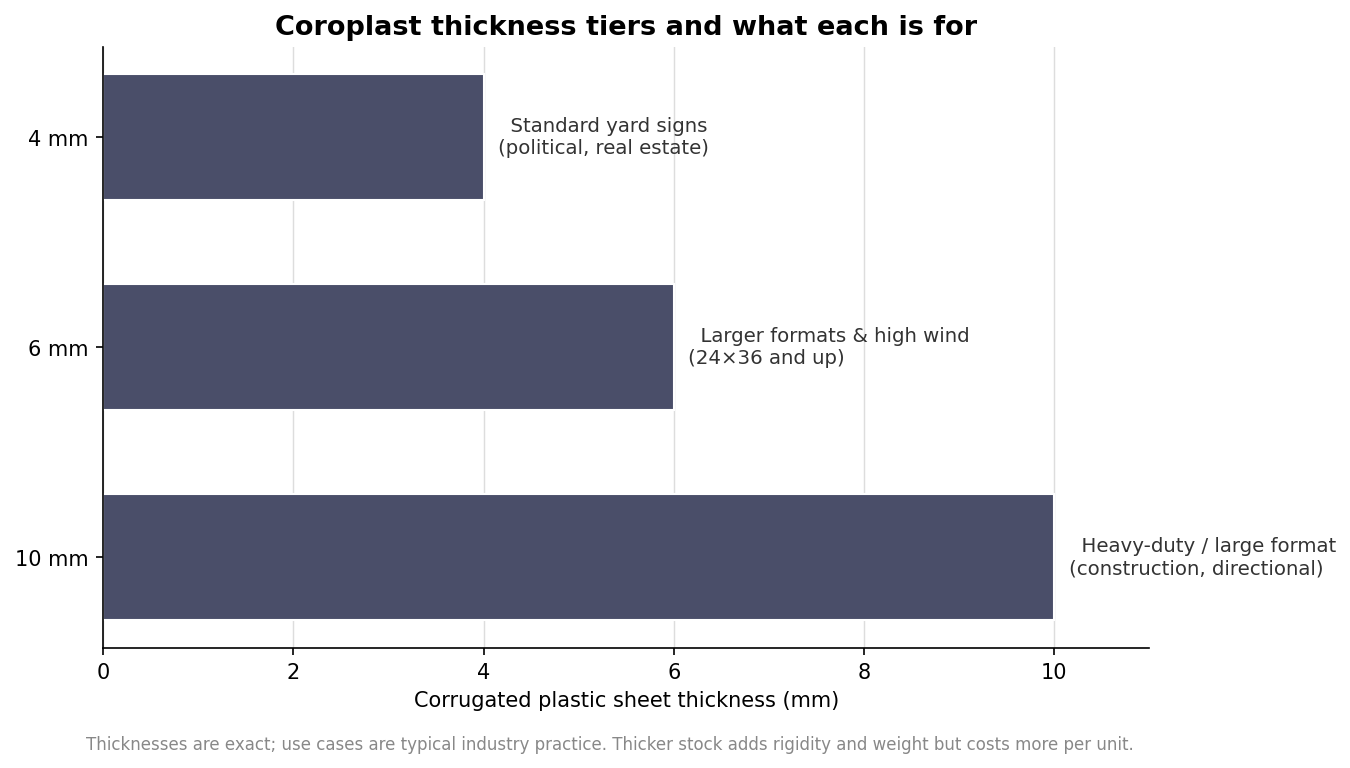
    Horizontal bar chart of coroplast thickness tiers 4mm, 6mm, and 10mm with their typical uses
    Thickness scales with sign size and wind load: 4mm for lawn signs, 6mm for larger formats, 10mm for heavy-duty.

    Flute direction and why H-stakes fail without it

    This is the spec that quietly ruins orders. The flutes run in one direction through the sheet, and an H-stake works by sliding its two wire legs up inside those hollow channels from the bottom edge. For that to happen, the flutes have to run vertically when the sign is standing, so the channels line up with the legs. Order the same artwork with the flutes running the other way and the stake legs hit a wall of solid plastic ribs, and the sign simply will not mount.

    Always specify flute direction relative to how the sign is displayed, not how the art is drawn. A landscape 24 by 18 inch sign and a portrait 18 by 24 inch sign can carry identical artwork yet need the flutes oriented differently so both stand upright on a stake. Reputable printers ask, or default to vertical flutes for stake mounting, but do not assume; state it. One more limit worth knowing: once a sign gets very large, past roughly four feet in the stake direction, the flute run is too long for a wire stake to grip, and those signs move to frames, grommets, or posts instead. If your plan is a stake in the lawn, keep the sign within stake-friendly dimensions and confirm the flutes run the way the stake goes in.

    How long a coroplast sign really lasts outdoors

    Coroplast is not built for permanence, and vendor lifespan claims swing wildly because they measure different scenarios. A printed yard sign working hard in full sun through an election or a listing is commonly expected to hold up for a couple of months, on the order of 60 to 90 days, before UV exposure starts to dull the ink and the polypropylene grows brittle. The same material sheltered from direct sun, printed with UV-cured inks or protected with a laminate, can last far longer, with some suppliers citing multiple years under moderate conditions. Both claims can be true at once because the variable is sunlight, not the plastic.

    Treat any single lifespan number with suspicion and plan around the exposure instead. For a short campaign, 4mm coroplast with standard printing is the correct, economical choice and durability is a non-issue. For signage that has to survive a full season or more outdoors, budget for UV-cured or laminated printing, consider a thicker grade, and site the sign out of the harshest sun where you can. The figures below are indicative ranges to plan against, not guarantees.
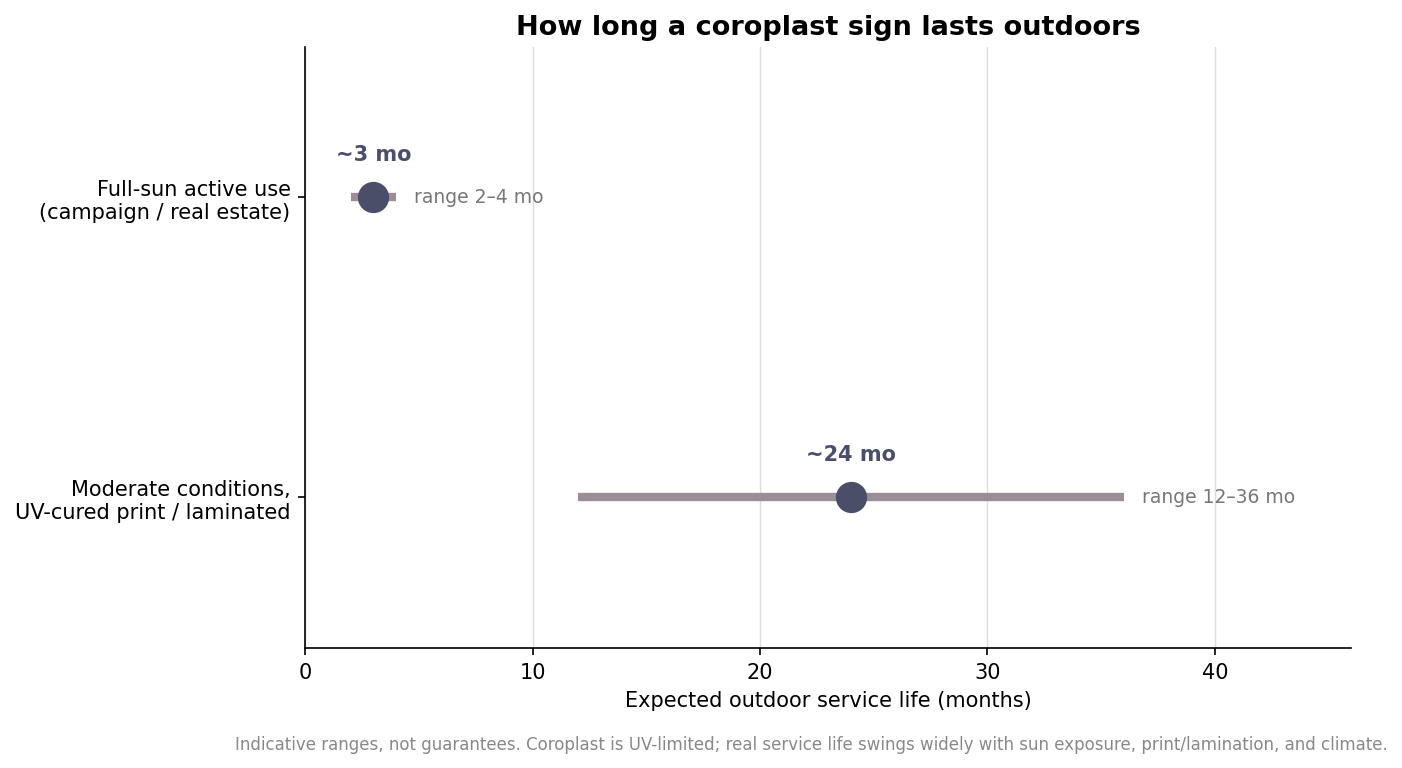
    Dot-and-range chart of coroplast outdoor service life for full-sun use versus moderate UV-protected conditions
    Expected service life hinges on sun exposure and print protection, not on the plastic alone.

    Specifying coroplast without regret

    Three lines on the order sheet cover it. State the thickness, 4mm for standard lawn signs, 6mm for larger or windy installs, 10mm for large-format and heavy-duty. State the flute direction relative to the display orientation so the H-stake actually inserts. And state the print protection to match the intended service life, plain printing for short-run signs, UV-cured or laminated when the sign has to last. Do that and coroplast does exactly what it is famous for: a clean, weatherproof sign that goes up fast, stands where you put it, and costs very little to produce in quantity. Skip a line, and the failure shows up in the field where it is expensive to fix.
  • What Size Yard Sign Do You Actually Need? Standard Dimensions, Matched to the Job

    What Size Yard Sign Do You Actually Need? Standard Dimensions, Matched to the Job

    Most yard sign orders go wrong in the same quiet way: the size gets chosen by habit or by price, not by where the sign will stand or who has to read it. A sign that is perfect on a front lawn disappears at a busy intersection, and a jumbo panel meant for a highway corner is a waste of money stapled to a picket fence. The good news is that the decision is not really about taste. It comes down to two things you can measure — how far away your reader is, and how tall your biggest word needs to be — and once you know those, the size almost picks itself.

    The four sizes that cover almost every job

    Yard signs cluster around a handful of dimensions, and four of them handle the overwhelming majority of orders. 12 by 18 inches is the small, close-range size: directional arrows, “Parking,” “Check-in this way,” open-house pointers — anything read from a sidewalk or a driveway with only a word or two on it. 18 by 24 inches is the standard, and it earns that title; it is the practical default for campaign lawns, real estate listings, local services, events, and hiring signs, with room for a name, a line of service, and a phone number. 24 by 36 inches steps up when 18 by 24 feels lost on the property — large yards, corner lots, business entrances, or a message that needs a headline plus a disclaimer. Above that sit the oversized 4-foot formats such as 4 by 8 feet, which give billboard-style reach for a few strategic anchor placements rather than broad distribution. Real estate riders, the narrow 6 by 24-inch strips that clip onto a post to add “Sold” or an agent’s name, round out the set.

    The rule that actually chooses the size

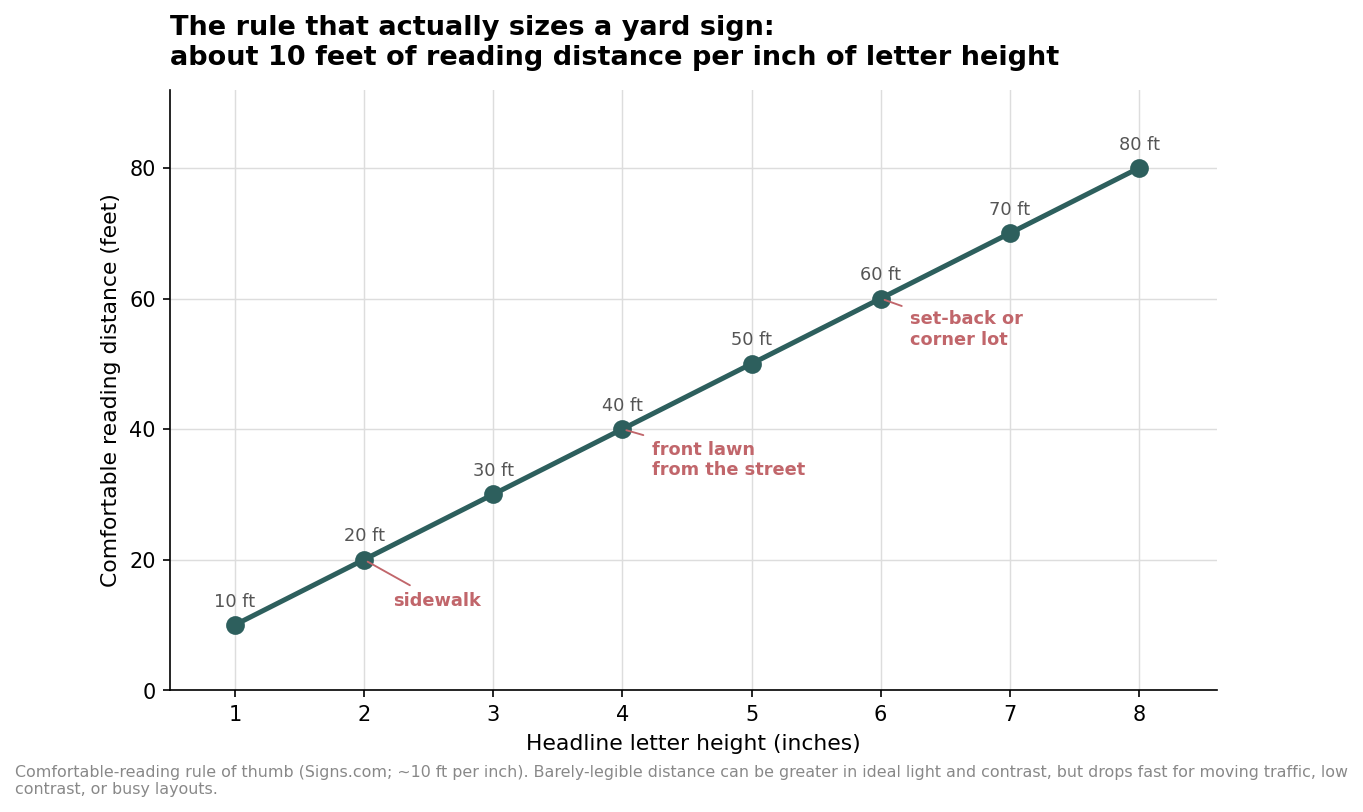
    Sign professionals lean on a simple relationship between letter height and reading distance: roughly every inch of letter height buys about ten feet of comfortable reading distance. Two-inch letters read cleanly from around twenty feet, which suits a sidewalk. Four-inch letters carry to about forty feet, the distance from a front lawn to a passing car. Six-inch letters reach roughly sixty feet, which is what a set-back house or a corner lot needs. The chart below traces that line.

    Line chart showing comfortable reading distance in feet rising about ten feet for every inch of yard sign letter height
    The working rule: roughly ten feet of comfortable reading distance for every inch of letter height.

    Two honest caveats keep this from becoming a trap. The “ten feet per inch” figure is for comfortable reading; a letter can be just barely legible from farther away in ideal light with strong contrast, but that margin collapses the moment the reader is moving, the contrast is weak, or the sign is crowded with extra lines. And the number is driven by your largest word. If the headline is legible but the phone number underneath is half the height, plan the sign around the phone number, because that is the line people actually need when they are ready to act.

    Working backward from the sign to its size

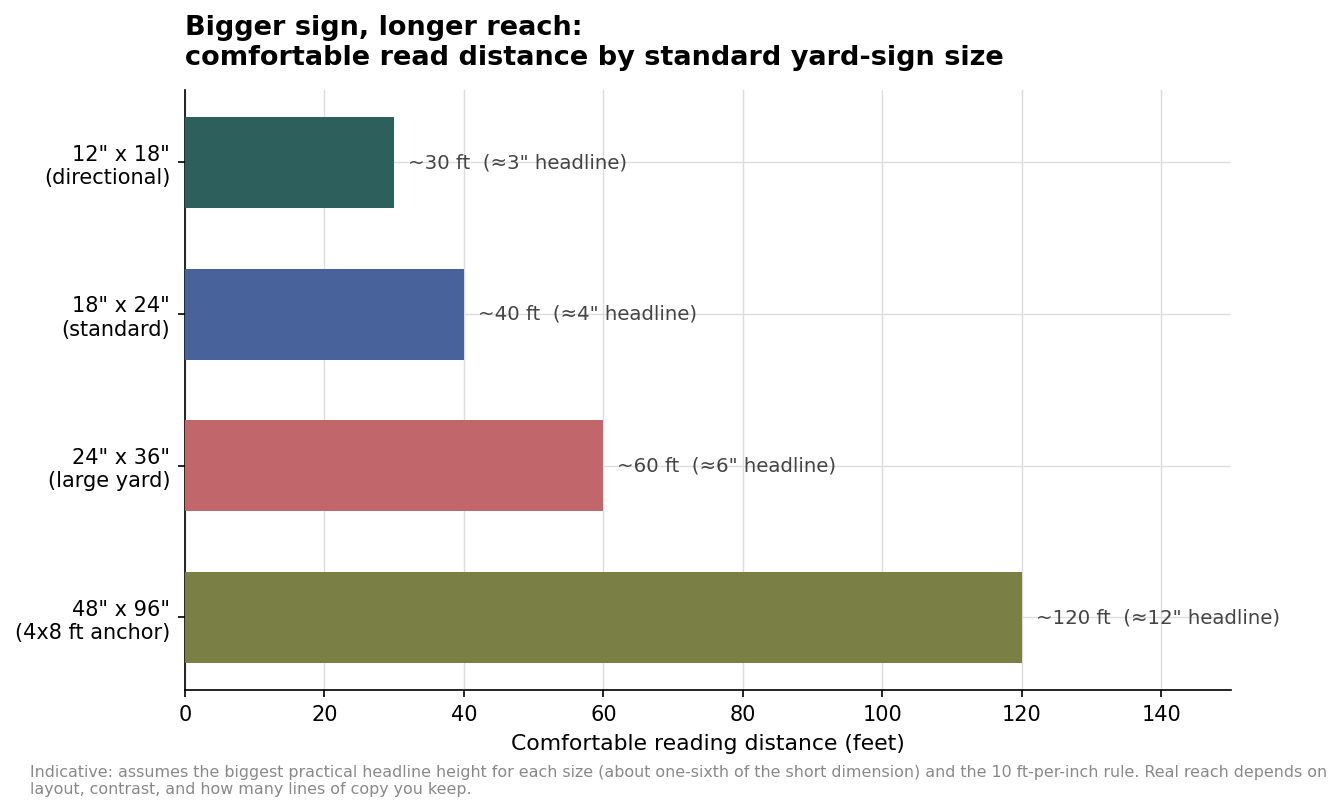
    Because letter height is capped by the physical panel, size and reach travel together. Fit the biggest headline a given size can carry — a rough guide is letters about one-sixth of the sign’s short dimension, leaving room for the rest of the copy — and each size lands at a predictable range.

    Horizontal bar chart of comfortable reading distance for 12x18, 18x24, 24x36, and 4x8 foot yard signs
    Each standard size, plotted at the biggest practical headline it can carry, lands at a predictable reading distance.

    Read that against your placement and the answer is usually obvious. A real estate sign viewed from the street wants 18 by 24 or, on a deep lot, 24 by 36, with a rider for status. A political or campaign lawn sign is the textbook 18 by 24; the money is better spent on more of them in more yards than on a handful of giants. Event and directional signage splits between 12 by 18 for the up-close arrows and 18 by 24 for the main entrance. A business or grand-opening message on a busy road is where 24 by 36 or a 4 by 8-foot panel finally earns its cost, because the reader is farther away and moving faster.

    Where the sign stands changes the answer

    The same message needs a different size depending on the ground it sits on. A sign flat against a sidewalk is read from ten or fifteen feet, so 12 by 18 with a short line is plenty. Push it to the middle of a lawn and the nearest reader is now thirty or forty feet back on the street, which is 18 by 24 territory. Put it on a corner lot where cars approach at an angle and slow down only briefly, and you need both more height and fewer words — 24 by 36 with a three or four-word headline beats a cluttered standard sign every time. Speed matters too: a driver at 35 miles per hour has a second or two, so the faster the road, the larger the letters and the shorter the copy.

    Buying in bulk without over-ordering

    For a bulk run, the trap is buying one size for everything. Most campaigns and rollouts are better served by a mix: a large volume of the standard 18 by 24 for broad placement, a smaller count of 24 by 36 for anchor corners and high-traffic spots, and a modest set of 12 by 18 for directional duty on the day. Decide single- versus double-sided by traffic flow, not reflex — a sign seen from both directions on a through street or a median genuinely needs two printed faces, while one pressed against a building or facing a single approach does not, and printing the back you will never show is pure waste. The oversized 4-foot panels are the easiest place to overspend, so treat them as a few deliberate placements rather than a default. Size each sign to its reader and its spot, order the mix that matches where the signs will actually stand, and the same budget covers far more ground.

  • How to Stake a Yard Sign So It Survives Wind and Wet Ground

    How to Stake a Yard Sign So It Survives Wind and Wet Ground

    A yard sign is only as reliable as the few inches of steel holding it in the ground. Buyers spend hours on artwork and then lose signs to a Saturday gust because the stake was the wrong size or the sheet was cut the wrong way. Staking is not an afterthought; it is a spec you should decide before the order goes to print. Here is how to get it right the first time.

    Match the stake to the sign, not the other way around

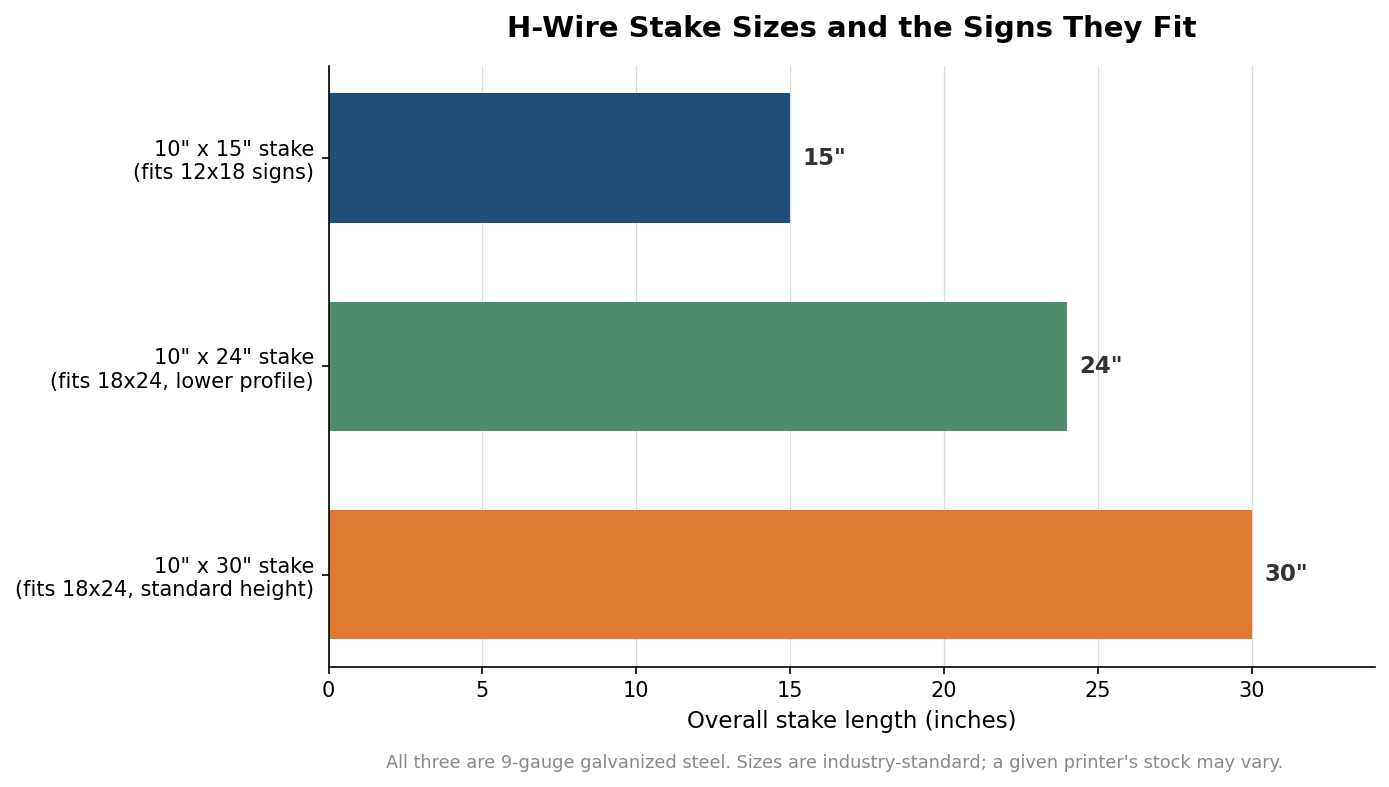
    The default hardware for a printed yard sign is the H-wire stake: a galvanized steel frame, usually 9-gauge, shaped like an H so two legs slide up into the sign and a crossbar rests against the bottom edge. These come in three common footprints, described as width by height: 10 by 15 inches, 10 by 24 inches, and 10 by 30 inches. The 15-inch frame suits a smaller 12 by 18 sign or an 18 by 24 sign you want to sit low to the ground. The 24-inch and 30-inch frames both carry the standard 18 by 24 sign, with the 30-inch version lifting it higher for visibility from the road. On the taller frames the crossbar typically sits about 8 inches down from the top, so the wire grips well inside the panel rather than at the very edge.

    Height is a trade-off, not a free upgrade. A taller stake raises the sign into sightlines but also hands the wind a longer lever. For an oversized 24 by 36 panel, one thin stake is rarely enough; step up to two stakes or a heavier gauge before you step up in height.

    Horizontal bar chart of H-wire stake sizes 10x15, 10x24, and 10x30 inches and the sign sizes each fits
    H-wire stakes come in three standard heights; taller frames lift the sign higher but catch more wind.

    Flute direction is the detail that quietly ruins orders

    Corrugated plastic, the material most yard signs are printed on, is not solid. It is two thin skins with hollow channels, called flutes, running between them. Those channels are what an H-stake grips: the wire legs slide up inside them. That only works if the flutes run vertically, top to bottom, on the finished sign. If they run side to side, the legs have nothing to slide into and you are reduced to zip-tying the sign to a fence.

    This is why print orders ask you to confirm flute direction, and why the safe instruction is to specify vertical flutes for any sign that will go on H-stakes. It costs nothing to get right and is expensive to discover in the field with a truckload of signs. The base sheet also comes in a few weights: 4 millimeter is the standard workhorse and handles signs up to about 18 by 24, 6 millimeter adds stiffness for larger formats or windy sites, and 10 millimeter is a heavy-duty option for construction and rough handling.

    Bar chart of corrugated plastic thickness options 4mm, 6mm, and 10mm with typical use cases
    Sheet thickness ranges from 4 mm for standard signs to 10 mm for heavy-duty use; thicker stock flexes less in wind.

    What actually keeps a sign standing in wind

    Three things decide whether a sign rides out a storm: how deep the stake goes, how many stakes carry the load, and how much sail area the panel presents. Drive the stake in far enough that a good portion of its length is below grade; a stake pushed in only a couple of inches will pivot out of soft ground the first time it is loaded. For anything larger than a standard sign, or any exposed corner lot, use two H-stakes rather than one, set slightly splayed so they resist twisting as well as tipping.

    It is tempting to reach for the tallest, heaviest stake in windy conditions, but that often backfires. A very tall frame gives the wind more leverage, and a taller sign simply catches more air. In genuinely exposed spots, a standard-height stake in thicker 6 millimeter stock is usually steadier than a tall stake in thin 4 millimeter. Double-sided printing is worth a thought here too: a two-sided sign reads from both directions but presents a full face to the wind no matter which way it blows, so it earns the sturdier setup.

    One honest caveat on the material itself. Corrugated plastic is built for temporary campaigns. Under constant sun the polypropylene slowly turns brittle, and a realistic outdoor life is on the order of 60 to 90 days for a typical run rather than years. If the sign needs to stand for a full season or longer, that is a signal to move to a thicker sheet or a more durable substrate, not just a bigger stake.

    Ground type changes the whole calculation

    The same stake behaves very differently depending on what you push it into. In soft or wet soil, insert the stake at a slight backward lean and go deeper than you think you need, because saturated ground loses its grip fast. In dry, compacted, or rocky ground, start a pilot hole with a screwdriver or rebar so you are not bending the wire trying to force it. Frozen ground in winter is its own problem and usually calls for a pilot hole or a heavier goal-post style base. On pavement or indoor floors there is no ground to grip at all, so plan for an A-frame or a weighted base instead of wire stakes, and order the sign flat rather than fluted for stakes.

    A short spec sheet to hand your printer

    When you place the order, the four things worth stating explicitly are the sheet weight, the flute direction, the stake size, and the stake count. A workable default for a standard lawn campaign is an 18 by 24 sign on 4 millimeter stock with vertical flutes, paired with a 10 by 30 inch H-stake. For exposed sites, larger formats, or anything that has to last past a couple of months, move to 6 millimeter stock and two stakes, and drop the display height rather than raising it. Decide those four numbers up front and the signs will still be standing when the campaign ends, which is the only performance metric that matters.

  • Where You Can Legally Place Yard Signs: Right-of-Way, Size Limits, and HOA Rules

    Where You Can Legally Place Yard Signs: Right-of-Way, Size Limits, and HOA Rules

    A yard sign only works if it stays in the ground. Signs get pulled, ticketed, or quietly thrown away every day, and almost always for the same reason: they were placed somewhere the owner had no right to place them, or built to a size the local code does not allow. Before you order a run, it helps to understand the handful of rules that decide whether a sign survives its first week. What follows is general information, not legal advice, and the specifics change from one town to the next, so treat local ordinances and your printer’s guidance as the final word.

    The public right-of-way is where signs disappear

    The strip of land between the sidewalk and the street, along with medians, shoulders, utility poles, and traffic islands, is public right-of-way, and it is generally illegal to place a sign there without a permit. This is the single most common reason signs vanish: crews can remove them without notice, and some cities issue fines. Cities including Atlanta, Dallas and Los Angeles have reported fines for signs in the right-of-way, so the cost of guessing wrong adds up quickly across a large placement. The safe zone is private property with the owner’s permission, set back from public land. Typical guidance is to keep a sign roughly two to five feet back from the sidewalk, five to ten feet from the street curb, and two to three feet inside a property line to avoid a neighbor dispute. Those numbers are conventions rather than universal law, but staying inside them keeps a sign out of the right-of-way and out of sight lines at intersections, where obstructing driver visibility is a separate violation.

    Private property still has rules

    Placing a sign on your own lawn, or someone else’s with permission, is the legal foundation, but private ground is not a free-for-all. Municipal codes still govern how large a sign can be, how tall it can stand, how many you can display, and sometimes how close to the road it sits. Permission also has to be genuine: putting a sign on another person’s yard without their consent, even a political one, is not something the placer has a right to do, and the property owner can remove it. When you are running a real estate, event, or campaign program across many yards, collect permission deliberately rather than assuming a friendly wave counts.

    Size and height are capped, so design to the cap

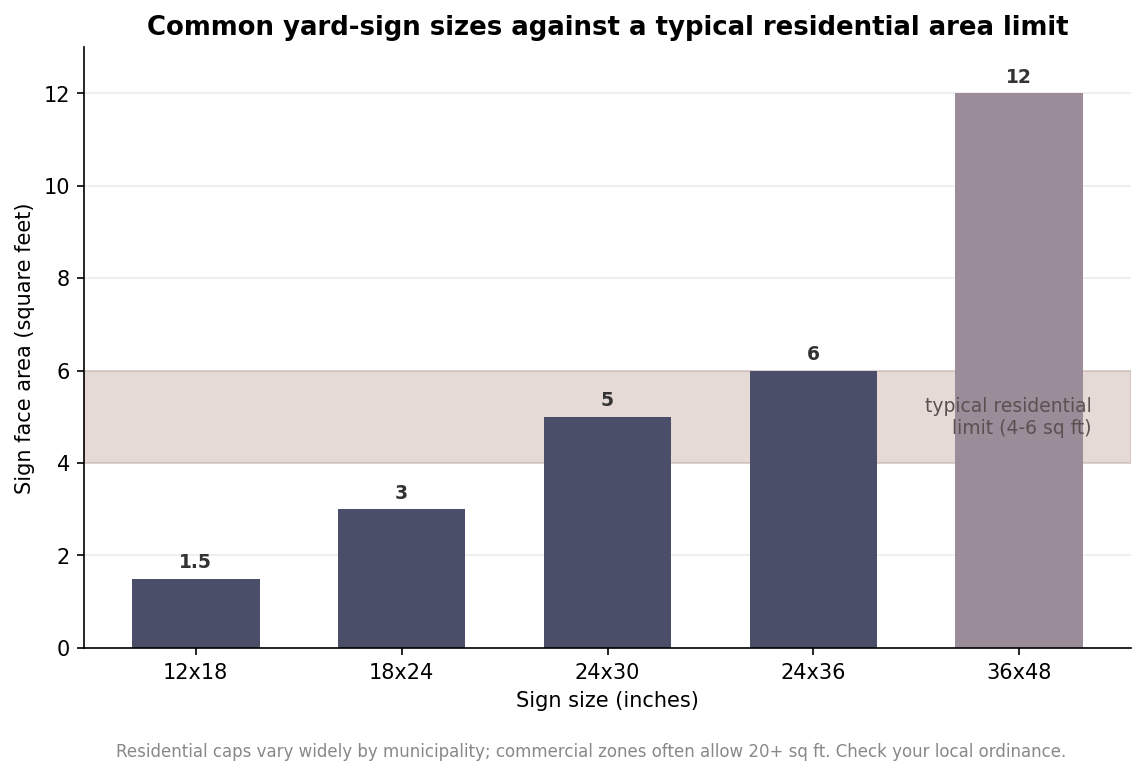
    Most residential zones limit a single sign’s face to somewhere around four to six square feet, with a height ceiling often near three to four feet above the ground; commercial zones frequently allow far more, sometimes twenty square feet or higher. This is why the standard sizes exist. An 18-by-24-inch sign, the most common yard format and the one that fits nearly every off-the-shelf H-wire stake and frame, is exactly three square feet, comfortably under a typical residential cap. Step up to 24-by-36 inches for busy roads and you are at six square feet, right at the edge of many limits. The chart below lines up the usual sizes against a typical residential band so you can see which ones stay clear.

    Bar chart of common yard sign face areas in square feet against a typical residential size limit band of four to six square feet
    Common sign sizes against a typical residential area cap; 18×24 in. is three square feet.

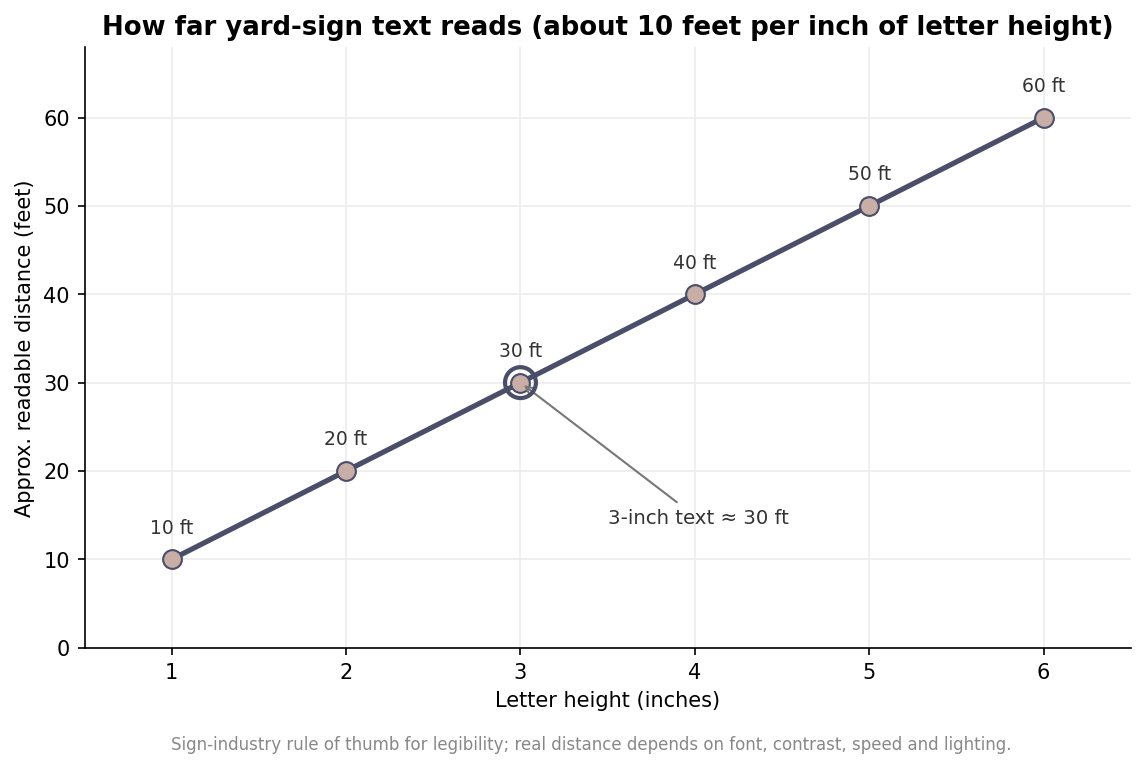
    Size also has to answer to distance. A common legibility rule of thumb gives roughly ten feet of readable distance per inch of letter height, so three-inch text reads at about thirty feet, which suits a suburban lawn but is far too small for a car moving past a wide arterial. Sizing the sign and the type to the setback matters as much as staying under the legal limit, because a compliant sign nobody can read is wasted.

    Line chart showing readable distance in feet increasing with letter height using the ten feet per inch rule of thumb
    A legibility rule of thumb: about ten feet of readable distance per inch of letter height.

    HOAs and the political-sign question

    Homeowners associations can impose stricter limits than the city, capping dimensions, banning certain sign types outright, or requiring pre-approval, and those covenants are generally enforceable on the properties that signed them. Political signs are a special case. The Supreme Court’s 2015 decision in Reed v. Town of Gilbert held that sign rules which treat signs differently based on what they say are content-based and face strict scrutiny, which has invalidated many ordinances that singled out political or temporary signs for tighter size or timing limits. Several states also have statutes addressing election signs; illustrative examples of display windows include Georgia at roughly sixty days before and seven after an election, and Texas and California nearer ninety days before and about ten after. Treat those figures as examples that change with the law and the jurisdiction rather than a rule you can rely on, and confirm the current window locally before a campaign.

    A short checklist before you stake anything

    Three questions cover most of the risk. First, whose land is this, and do I have permission that would hold up if the owner were asked. Second, am I clear of the public right-of-way, roughly the setbacks above and never on poles, medians, or shoulders. Third, does the sign fit the local size and height limits, and is the type large enough to read at the speed traffic passes it. Ordering to a standard 18-by-24 or 24-by-36 format on a proper stake handles the hardware and keeps most residential placements compliant, while anything larger or closer to the road deserves a look at the specific ordinance first. Getting these settled before the print run means you order the right size once and spend placement day putting signs in the ground rather than picking them back up.

  • How Many Yard Signs Should You Order?

    Nearly everyone under-orders, and the reason is that yard-sign pricing drops steeply with volume, so the difference between ordering enough and ordering too few is usually smaller than people assume.

    Campaigns

    Plan on signs for supporters who ask, plus a reserve of roughly a third for replacements, high-visibility intersections and the ones that disappear. A campaign that runs out of signs three weeks before the vote has bought advertising and then switched it off at the worst moment.

    Contractors and trades

    Work out how many jobs run concurrently, multiply by the number of weeks a sign stays on site, and add spares. Most trades cycle the same twenty to fifty signs all year, collecting as they go — the batch is a fixed asset, not a per-job cost.

    Events and weddings

    Walk the route from the main road to the door and count the decisions a driver has to make. Every turn is a sign; every ambiguous fork is two. Order arrow sets in left, right and straight variants rather than one design flipped, because you will need all three.

    Open houses

    Four to six signs per property is typical: one at the property, and a chain from the nearest main road. Agents who buy a set of twenty and reuse them across listings spend far less per weekend than those ordering per house.

    What volume actually does to price

    The per-sign price falls sharply as quantity rises, because setup is fixed and the printing itself is fast. This is why the minimum here is 12 but almost nobody stops there — ask for pricing at two or three quantities on the same quote and pick after you have seen the difference.

  • Yard Sign Design: The Two-Second Rule and What It Forces You to Cut

    A yard sign is not a poster, a flyer or a billboard. It is read at speed, from an angle, by somebody who was not looking for it. Every design rule below comes out of that one fact.

    Count the words

    The practical ceiling is about seven words on the whole sign, and fewer is better. A name, a category and a phone number is a complete sign. Adding a slogan does not add a message; it shrinks the message you already had.

    The test: read your draft aloud in two seconds. If you cannot, it is too long — not too small.

    Contrast beats color

    Legibility at distance is about the difference in lightness between the type and the background, not the hue. Dark navy on white reads at forty feet. Mid-blue on mid-red does not, however good the brand guide says it looks.

    If you must use two brand colors of similar lightness, put one of them on a white field rather than against the other.

    Size the phone number, not the logo

    The instinct is to make the logo dominant. On a lawn sign, the number people need to act is the thing that has to be biggest after the name. A logo that reads at ten feet and a number that does not is a sign that generates recognition and no calls.

    Kill the website and the QR code

    Nobody types a URL from a moving car and nobody scans a QR code from one either — the scan needs the driver to stop, get out, and hold a phone steady at a sign in a verge. Put the URL on the van; put the number on the sign.

    What we do about it

    We lay out every order before you pay, and where we think the design will not read we send a second version alongside yours in the same free mockup. You still choose. You just get to choose having seen both.

  • Coroplast vs Aluminum: Which Yard Sign Material to Order

    Two materials cover almost every yard sign ordered. Picking between them is genuinely simple once you know how many times the sign will be planted.

    Corrugated plastic (coroplast)

    A four-millimeter fluted plastic sheet, printed direct with UV inks. It is light, cheap at volume, weatherproof, and stiff enough to stand in wind when the flutes run vertically and an H-stake is in them.

    It handles a full outdoor season comfortably and usually much longer. What eventually retires a coroplast sign is fading, or a corner that got run over — not the weather.

    Aluminum composite (dibond-style)

    Three millimeters of rigid panel: two thin aluminum skins over a polyethylene core. It is heavier, considerably more expensive, and effectively permanent. It does not flex, does not fade quickly, and survives being pulled and replanted repeatedly.

    This is the material for a sign that lives in the back of a car and goes into twenty different lawns a year.

    The four questions

    How many times will it be planted? Once or twice: coroplast. Twenty times: aluminum. How long must it stay out? A season: coroplast. Years: aluminum. How many are you buying? Hundreds: coroplast, always. Does it hang in a frame? Then aluminum, because coroplast flexes in a hanging frame.

    The honest default

    Coroplast, for about nine orders in ten. Campaigns, contractors, events, markets, schools and open houses are all coroplast jobs. Agents with a permanent branded sign that moves between listings are the main exception, and they usually know it already.