A yard sign only works if it stays in the ground. Signs get pulled, ticketed, or quietly thrown away every day, and almost always for the same reason: they were placed somewhere the owner had no right to place them, or built to a size the local code does not allow. Before you order a run, it helps to understand the handful of rules that decide whether a sign survives its first week. What follows is general information, not legal advice, and the specifics change from one town to the next, so treat local ordinances and your printer’s guidance as the final word.
The public right-of-way is where signs disappear
The strip of land between the sidewalk and the street, along with medians, shoulders, utility poles, and traffic islands, is public right-of-way, and it is generally illegal to place a sign there without a permit. This is the single most common reason signs vanish: crews can remove them without notice, and some cities issue fines. Cities including Atlanta, Dallas and Los Angeles have reported fines for signs in the right-of-way, so the cost of guessing wrong adds up quickly across a large placement. The safe zone is private property with the owner’s permission, set back from public land. Typical guidance is to keep a sign roughly two to five feet back from the sidewalk, five to ten feet from the street curb, and two to three feet inside a property line to avoid a neighbor dispute. Those numbers are conventions rather than universal law, but staying inside them keeps a sign out of the right-of-way and out of sight lines at intersections, where obstructing driver visibility is a separate violation.
Private property still has rules
Placing a sign on your own lawn, or someone else’s with permission, is the legal foundation, but private ground is not a free-for-all. Municipal codes still govern how large a sign can be, how tall it can stand, how many you can display, and sometimes how close to the road it sits. Permission also has to be genuine: putting a sign on another person’s yard without their consent, even a political one, is not something the placer has a right to do, and the property owner can remove it. When you are running a real estate, event, or campaign program across many yards, collect permission deliberately rather than assuming a friendly wave counts.
Size and height are capped, so design to the cap
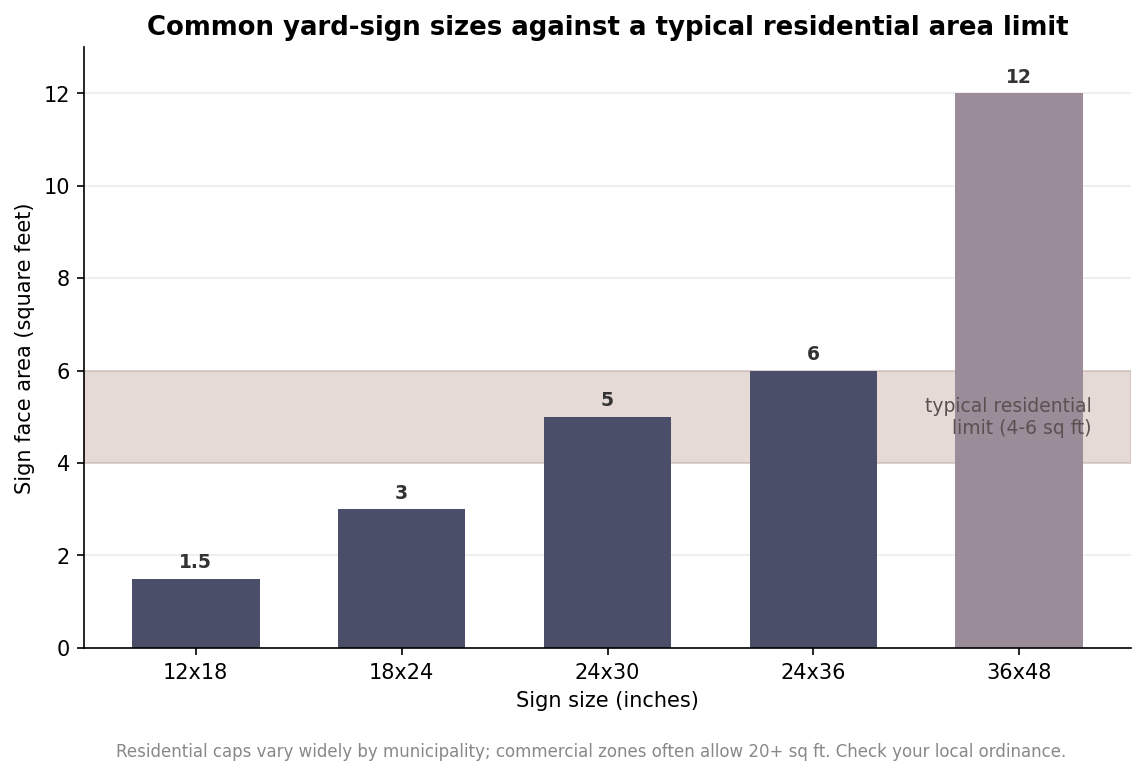
Most residential zones limit a single sign’s face to somewhere around four to six square feet, with a height ceiling often near three to four feet above the ground; commercial zones frequently allow far more, sometimes twenty square feet or higher. This is why the standard sizes exist. An 18-by-24-inch sign, the most common yard format and the one that fits nearly every off-the-shelf H-wire stake and frame, is exactly three square feet, comfortably under a typical residential cap. Step up to 24-by-36 inches for busy roads and you are at six square feet, right at the edge of many limits. The chart below lines up the usual sizes against a typical residential band so you can see which ones stay clear.
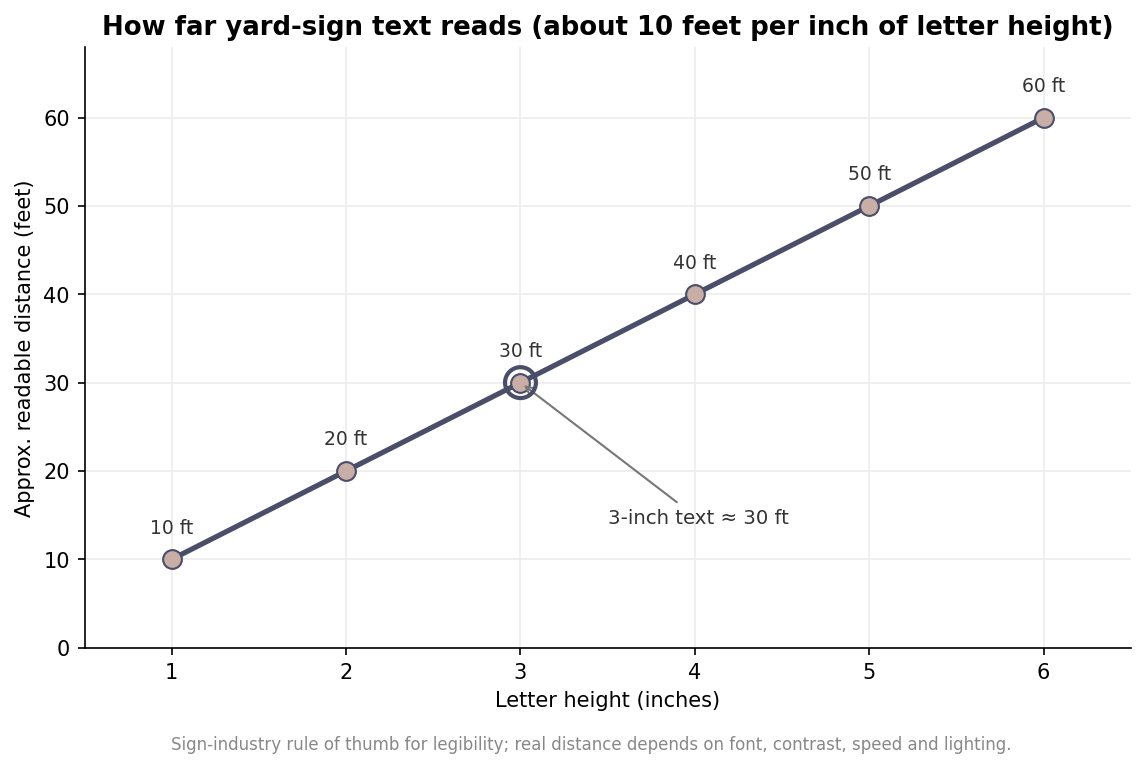
Size also has to answer to distance. A common legibility rule of thumb gives roughly ten feet of readable distance per inch of letter height, so three-inch text reads at about thirty feet, which suits a suburban lawn but is far too small for a car moving past a wide arterial. Sizing the sign and the type to the setback matters as much as staying under the legal limit, because a compliant sign nobody can read is wasted.
HOAs and the political-sign question
Homeowners associations can impose stricter limits than the city, capping dimensions, banning certain sign types outright, or requiring pre-approval, and those covenants are generally enforceable on the properties that signed them. Political signs are a special case. The Supreme Court’s 2015 decision in Reed v. Town of Gilbert held that sign rules which treat signs differently based on what they say are content-based and face strict scrutiny, which has invalidated many ordinances that singled out political or temporary signs for tighter size or timing limits. Several states also have statutes addressing election signs; illustrative examples of display windows include Georgia at roughly sixty days before and seven after an election, and Texas and California nearer ninety days before and about ten after. Treat those figures as examples that change with the law and the jurisdiction rather than a rule you can rely on, and confirm the current window locally before a campaign.
A short checklist before you stake anything
Three questions cover most of the risk. First, whose land is this, and do I have permission that would hold up if the owner were asked. Second, am I clear of the public right-of-way, roughly the setbacks above and never on poles, medians, or shoulders. Third, does the sign fit the local size and height limits, and is the type large enough to read at the speed traffic passes it. Ordering to a standard 18-by-24 or 24-by-36 format on a proper stake handles the hardware and keeps most residential placements compliant, while anything larger or closer to the road deserves a look at the specific ordinance first. Getting these settled before the print run means you order the right size once and spend placement day putting signs in the ground rather than picking them back up.