Most yard sign orders come down to one material: coroplast, the corrugated plastic that props up campaigns, open houses, and grand-opening arrows on every street corner. It looks like a single product, but two coroplast signs can behave very differently depending on two numbers you may never have thought about, the sheet thickness and the flute direction. Get either wrong and the sign either bends in the first gust or refuses to take a stake at all. Here is what those specs mean and how to order them on purpose.
What coroplast actually is
Coroplast is a genericized brand name for extruded corrugated polypropylene: two flat plastic faces bonded to a middle layer of hollow vertical channels, exactly like cardboard with the paper swapped for plastic. Those hollow channels are the flutes, and they are the whole reason the material is light, cheap, weatherproof enough for short outdoor runs, and able to swallow a wire stake. The polypropylene is naturally water-resistant, so rain is a non-issue. Sun is the real enemy, which is why lifespan, covered below, is the spec buyers most often misjudge.
Thickness: 4mm, 6mm, and 10mm
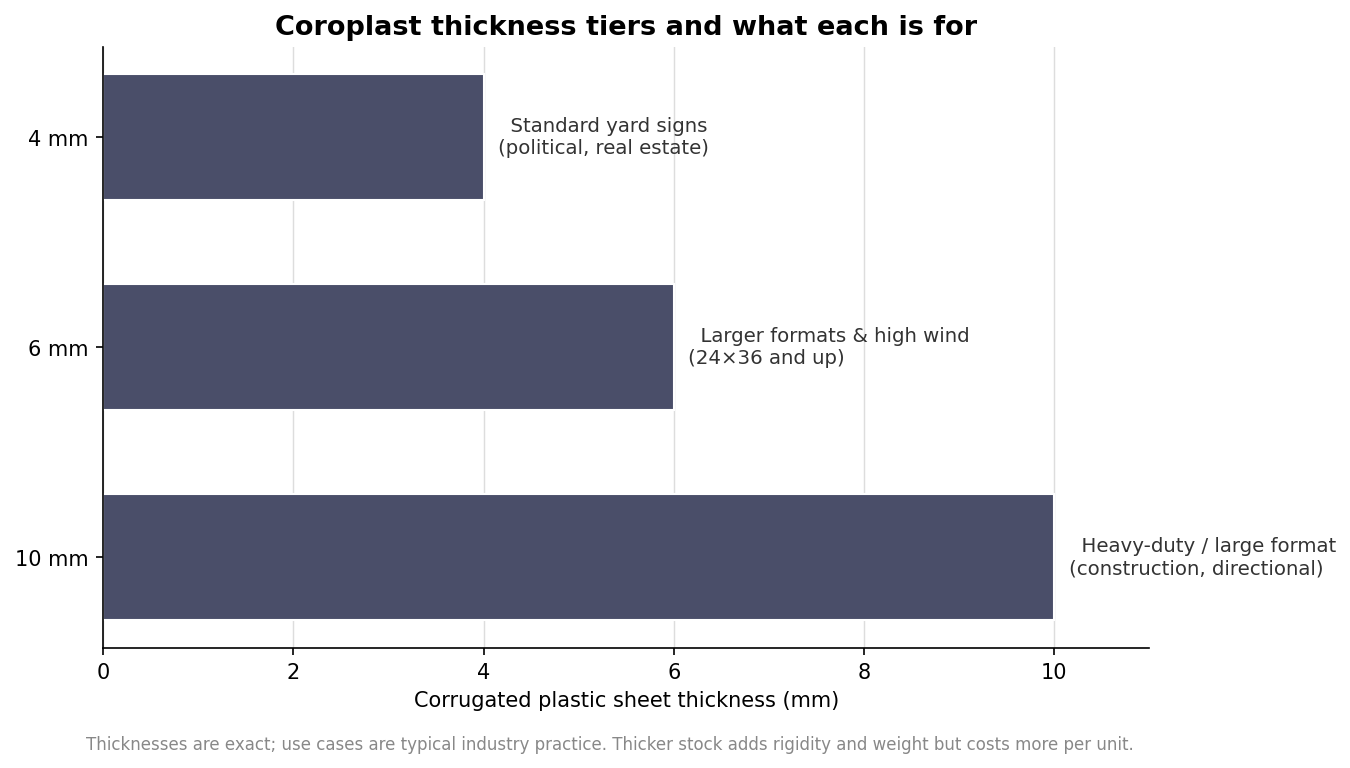
Thickness is the first lever. The default for standard yard signs is 4mm, the workhorse grade behind virtually all political and real estate signage at sizes up to about 18 by 24 inches, supported by an H-wire stake. It is light and rigid enough for the job and the cheapest to print at volume. Step up to 6mm when the sign gets bigger, roughly 24 by 36 inches and up, or when it will live in a windy, exposed spot. The extra millimeters buy meaningful stiffness while keeping weight low, so the panel does not flex and fatigue at the stake line.
The heavy grade is 10mm, chosen for maximum rigidity and impact resistance on large-format directional signs, construction-site boards, and anything that has to stand flat without a frame at sizes up to four by eight feet. The tradeoff is straightforward: each step up in thickness adds rigidity and weight but also cost per unit, so there is no reason to pay for 10mm on a lawn sign that a 4mm sheet handles fine. Match the grade to the size and the wind, not to a vague sense that thicker is safer.
Flute direction and why H-stakes fail without it
This is the spec that quietly ruins orders. The flutes run in one direction through the sheet, and an H-stake works by sliding its two wire legs up inside those hollow channels from the bottom edge. For that to happen, the flutes have to run vertically when the sign is standing, so the channels line up with the legs. Order the same artwork with the flutes running the other way and the stake legs hit a wall of solid plastic ribs, and the sign simply will not mount.
Always specify flute direction relative to how the sign is displayed, not how the art is drawn. A landscape 24 by 18 inch sign and a portrait 18 by 24 inch sign can carry identical artwork yet need the flutes oriented differently so both stand upright on a stake. Reputable printers ask, or default to vertical flutes for stake mounting, but do not assume; state it. One more limit worth knowing: once a sign gets very large, past roughly four feet in the stake direction, the flute run is too long for a wire stake to grip, and those signs move to frames, grommets, or posts instead. If your plan is a stake in the lawn, keep the sign within stake-friendly dimensions and confirm the flutes run the way the stake goes in.
How long a coroplast sign really lasts outdoors
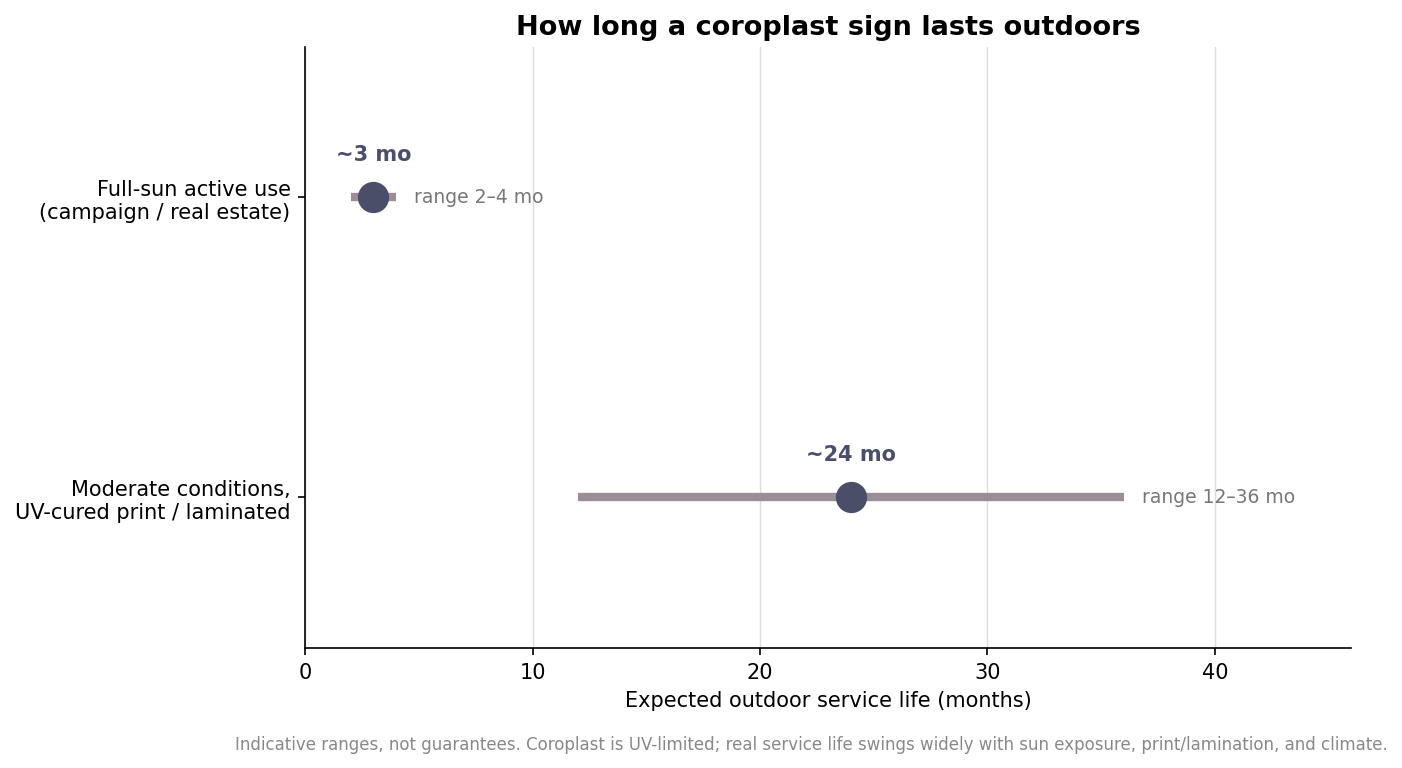
Coroplast is not built for permanence, and vendor lifespan claims swing wildly because they measure different scenarios. A printed yard sign working hard in full sun through an election or a listing is commonly expected to hold up for a couple of months, on the order of 60 to 90 days, before UV exposure starts to dull the ink and the polypropylene grows brittle. The same material sheltered from direct sun, printed with UV-cured inks or protected with a laminate, can last far longer, with some suppliers citing multiple years under moderate conditions. Both claims can be true at once because the variable is sunlight, not the plastic.
Treat any single lifespan number with suspicion and plan around the exposure instead. For a short campaign, 4mm coroplast with standard printing is the correct, economical choice and durability is a non-issue. For signage that has to survive a full season or more outdoors, budget for UV-cured or laminated printing, consider a thicker grade, and site the sign out of the harshest sun where you can. The figures below are indicative ranges to plan against, not guarantees.
Specifying coroplast without regret
Three lines on the order sheet cover it. State the thickness, 4mm for standard lawn signs, 6mm for larger or windy installs, 10mm for large-format and heavy-duty. State the flute direction relative to the display orientation so the H-stake actually inserts. And state the print protection to match the intended service life, plain printing for short-run signs, UV-cured or laminated when the sign has to last. Do that and coroplast does exactly what it is famous for: a clean, weatherproof sign that goes up fast, stands where you put it, and costs very little to produce in quantity. Skip a line, and the failure shows up in the field where it is expensive to fix.